






















































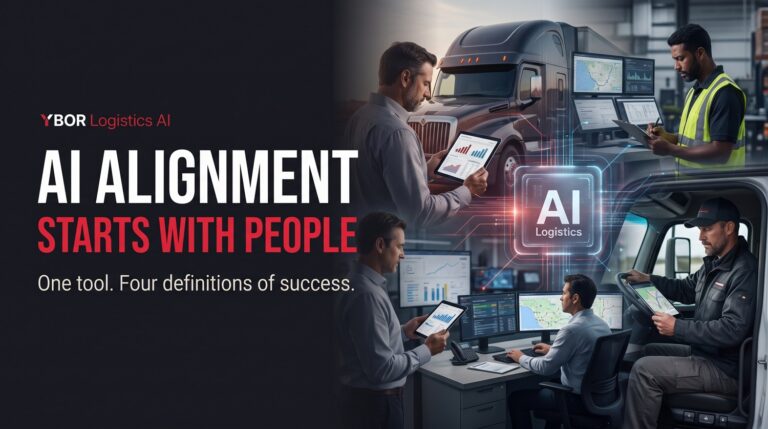
The scene
Carla owns a 30-truck fleet. Six months into an AI rollout, she called a meeting to find out why everyone seemed unhappy with a tool that, by her numbers, was doing its job.
She asked one question: «Is it working?»
Her dispatch manager said yes, because loads were getting covered faster. Her safety coordinator said no, because the tool kept suggesting schedules that pushed drivers close to their hours-of-service limits, and she was the one who had to explain it if something went wrong. Her lead driver said it was fine, but he’d stopped telling anyone when the suggested routes ignored where he could actually park a truck. Her accountant said he couldn’t tell, because nobody had told him what to look for.
Four people. Four honest answers. Not one of them was wrong.
Carla had assumed everyone wanted the same thing from the tool. In reality, each of them was measuring it against a different job, a different risk, and a different fear.
The pattern
Most rollouts are planned around the person who bought the tool. The owner sees the pitch, the ROI case, the demo. The decision gets made, the announcement goes out, and the assumption is that everyone else will come along.
But a small fleet isn’t one stakeholder. It’s at least four, and they each carry a different definition of success:
- Ownership is looking at cost per mile, margin, and whether the investment pays back.
- Dispatch and operations are looking at whether their day gets easier or harder, and whether the tool makes them look good or exposes mistakes.
- Drivers are looking at whether it respects their time, their route knowledge, and their judgment, or whether it’s one more thing watching them.
- Safety, compliance, and finance are looking at risk: who’s accountable if the tool’s suggestion causes a problem, and who has to document it.
None of these views is wrong. They’re just different jobs. And when a tool is introduced as if it serves one of them, the other three quietly start working around it.
The reframe
Alignment isn’t getting everyone to agree. It’s making sure everyone’s definition of «working» is on the table before the rollout starts, not discovered six months in.
This domain depends on the earlier ones. People will only tell you what they actually need if they feel safe doing it (#1). Decisions can only be shared across roles if leadership has loosened its grip (#3). And the numbers that matter to each group have to be visible to all of them (#7), or each group will keep optimizing for its own corner.
Engagement is the other half. Alignment is agreeing on the destination. Engagement is giving each group a real part in getting there, a say in how the tool is configured, a place to flag problems, and a visible response when they do. People defend what they helped build. They work around what was handed to them.
One thing you can check this week
Ask each of your stakeholder groups the same three questions, separately:
- What does «working» mean for your part of this operation?
- What would make this tool a problem for you?
- What do you need to see before you’d trust it with something important?
Write the answers side by side. Where they conflict, you’ve found the real design problem. Where one group’s answer is missing entirely, you’ve found the group that’s most likely to work around you.
One usable action: choose one person from each group (an owner or manager, a dispatcher, a driver, and whoever handles safety or finance) and put them on a small, informal rollout team. Their job is not to approve anything. It’s to tell you, once a week for the first month, what’s working and what isn’t for their part of the operation. Four people, fifteen minutes a week, and you’ll hear problems while they’re still cheap to fix.
Where this fits
This is domain eight of twelve. The next four move into the structures that protect everything built so far: regulatory and risk alignment, the AI your people are already using without telling you, governance, and the roles that change as a result.
If you’d like help working out who the right four voices are in your operation, or how to run that first weekly check-in so people actually speak up, I’m glad to walk through it with you. Reply with the role you think you hear from least.
YBOR Logistics AI
Helping logistics companies turn AI, automation and operational data into better decisions… Visit YborLogistics.ai